

(3 minute read)
Published: 12 June 2026
Written by: Sufina Ahmad, Director of John Ellerman Foundation and Dr Sophia Cooke, Strategic Initiatives Lead at Environmental Funders Network
Discover how the third round of the UKOTs fund will support conservation work in these remarkable ecosystems across the world.
Arguably the UK’s most important environmental treasures, the UK Overseas Territories (UKOTs) have long held John Ellerman Foundation’s attention. The Foundation has been providing environmental funding to groups working in the UKOTs since 2013, and has partnered with the Environmental Funders Network (EFN) to promote the importance of environmental funding in the UKOTs since 2021.
An overview of the UK Overseas Territories (UKOTs)
Scattered across the globe, the UKOTs are home to every major habitat type on earth, including rainforest, tundra, desert, coral reef, and icefield. These areas are crucibles of evolution, housing at least 94% of the UK’s unique endemic wildlife species and comprising the fifth-largest marine estate on the planet. Nature exists in the UKOTs at an unimaginably vast scale. If you care about our planet and are seeking to respond to the nature and climate crises, then the UKOTs matter.
For example:
- The Caribbean UKOTs, including the Cayman Islands, Anguilla, and the British Virgin Islands, host vibrant coral reefs, mangroves, and seagrass beds that protect coastlines, store carbon, and support globally significant marine biodiversity.
- The mid-Atlantic islands of St. Helena, Tristan da Cunha, and Ascension are havens for unique wildlife, such as the critically endangered St. Helena olive tree, the endemic wirebird, and vast seabird colonies, including the yellow-nosed albatross and Ascension frigatebird.
- The Falkland Islands host some of the largest penguin colonies on Earth, including five species, such as the iconic king and rockhopper penguins.
Despite their ecological significance, the UKOTs are often overlooked in global conservation efforts. International funders may consider them the responsibility of UK funders, while UK funders might not realise they can support work in the UKOTs. Their small populations and geographic isolation can make it difficult for local organisations to access the resources needed to protect these ecosystems. Threats from climate change, invasive species, and habitat degradation are growing, yet the UKOTs still receive just 0.03% of UK philanthropic funding. You can click here to read more about this in Where the Green Grants Went 9.
The work of the UKOTs Fund
In 2021, we launched the UKOTs Fund, which is a funder collaboration to support transformative and locally-led change in the UKOTs through responsive environmental grantmaking. This includes capacity-building, policy work and practical conservation efforts, with partnerships and community empowerment playing a critical role in achieving positive environmental outcomes.
In the first two rounds, we distributed around £1.8m to support 17 organisations in ten of the UKOTs. You can click here to read about the impact of these grants in the EFN report we commissioned 'The UK Overseas Territories Fund: An unparalleled opportunity for environmental philanthropy'.
In March 2026 we launched a third round of the UKOTs Fund, with a total of £1,014,858 available to distribute. This collaboration comprised seven committed environmental funders:
- Elgol Fund for Nature
- John Ellerman Foundation
- Lund Trust
- Simon Gibson Charitable Trust
- The Fishmongers’ Company
- The Ma’at Environment Fund
- An anonymous individual donor
We closed this round on 5 May 2026, having received 21 applications (compared to 27 applications in 2021 and 17 in 2022). The applications received related to 12 of the 15 UKOTs: Anguilla, Bermuda, British Antarctic Territory, British Virgin Islands, Cayman Islands, Cyprus Sovereign Base Area, Falkland Islands, South Georgia and the South Sandwich Islands, St Helena, Tristan da Cunha, Turks and Caicos Islands, and Montserrat. We did not receive applications relating to Pitcairn Islands, Gibraltar or Ascension Island. Four of the applications were deemed ineligible either because of their geography, because they requested funding for activities outside the scope of the UKOTs Fund, or because their annual income was below £100,000. This left 17 applications for discussion.
The decision-making panel, which was made up of representatives from most, but not all, of the funders involved in this round, met online on 20 May 2026 to discuss the applications. Their decisions were supported by the expertise and insights of EFN’s Dr Sophia Cooke, as well as John Ellerman Foundation’s Grants Team.
We are delighted to announce that the following eight applications were approved:
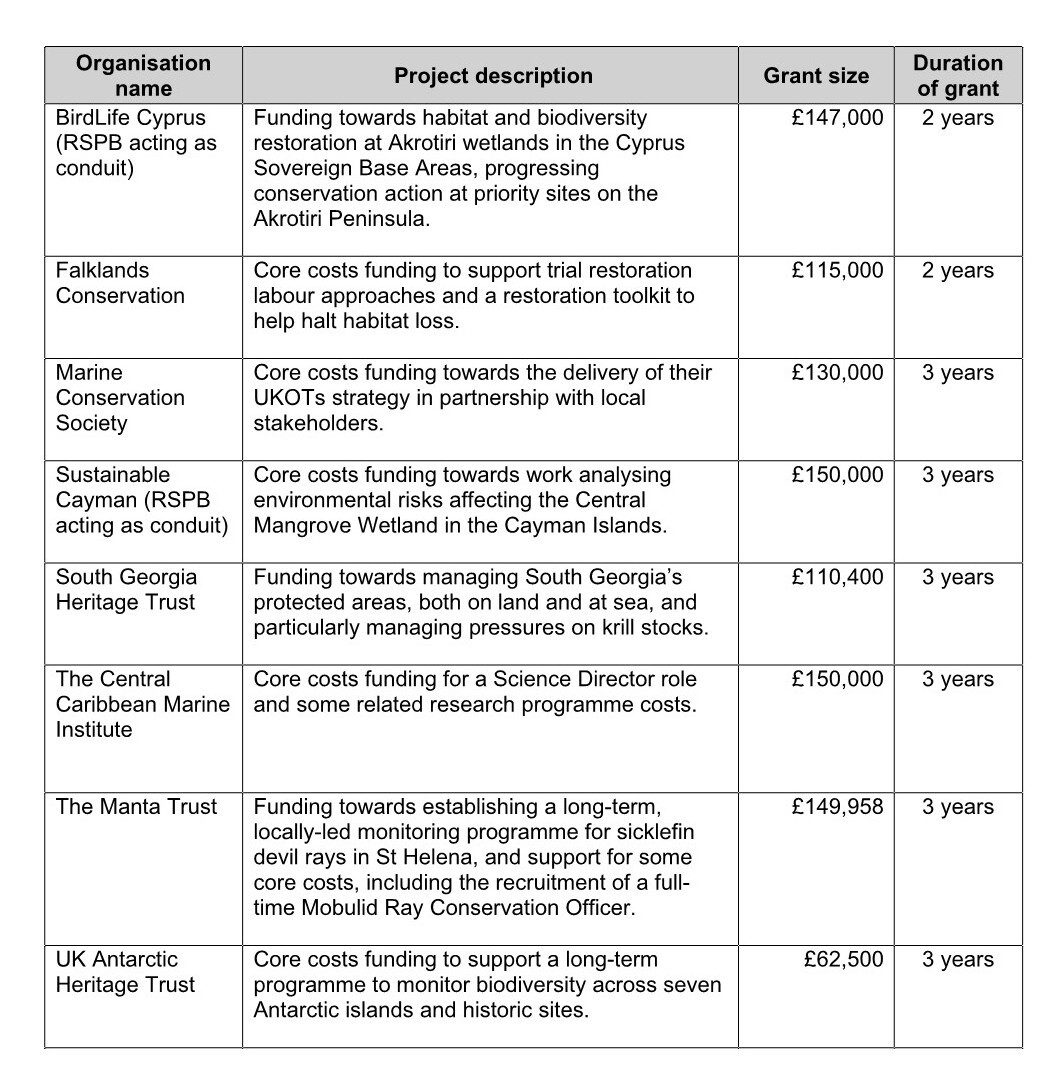
In terms of next steps, John Ellerman Foundation will be managing each of the grants and will ensure that all applicants receive any additional support they need.
We are really excited to work with these organisations and support them in the vital work they are doing across different UKOTs. We hope to continue to support work like this through the UKOTs Fund, and would very much welcome hearing from others who may wish to contribute funding. Contact Sufina if you’d like to get involved.